Paripurna and Ardha Navasana (Boat Pose)
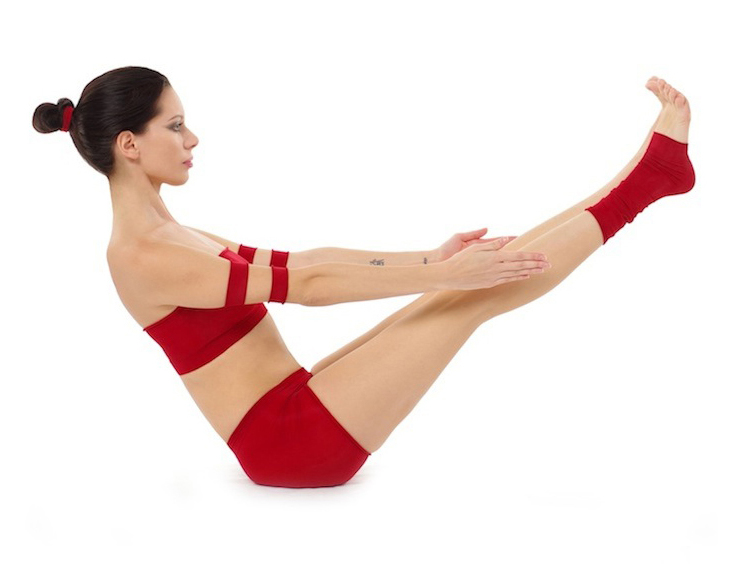
"Paripurna" means full, "nava" - boat. This asana resembles a boat with oars.
1. Stretch both legs out and sit in Dandasana. Take one or two breaths in and out.
2. Exhale and lean the trunk back a little, at the same time raising both legs off the floor.
3. The whole body balances on the buttocks. Keep the head and trunk, and the legs, straight. If the back drops, the trunk will also sink towards the floor. If the knees bend, the feet will go down. Therefore the legs must be kept firm and the trunk lifted upright.
4. Lift the arms off the floor and stretch them forward, parallel to the floor. Turn the palms inwards so that they face each other. The shoulders and the palms should be in line.
5. Stay in this position for 30-60 seconds; breathe normally. While doing so:
(1) keep the legs firm and rigid;
(2) keep the spine firm and steady - the head seems to float on it; if the head tips forward, the neck tightens and causes a feeling of heaviness in the head;
(3) look straight ahead; do not press the chin into the throat;
(4) do not let either the chest or the lower back drop in order to keep your balance;
(5) a feeling arises as if the body were weightless and floating like a boat; to achieve this, keep the spine firm.
6. Exhale, lower the arms and legs and come into Dandasana.
Special notes:(1) Do not touch the legs with the palms.
(2) If it is impossible to raise the arms after you have found your balance on the buttocks, try doing everything at once, that is:
a) leaning the trunk back,
b) lifting the legs,
c) lifting the arms.
Contraindications: pain in the lower back, herniated discs, injuries of the iliopsoas muscle, pregnancy.
A detailed description of Paripurna Navasana (full boat pose)In Paripurna Navasana (the full version of Boat Pose) the sitting bones press into the floor, the trunk and legs form the letter “V”, and the arms are stretched parallel to the floor. We hold this position through the work of the hip flexors and of the iliopsoas, which draws the thighs and the trunk towards each other. In addition, two groups of muscles contract strongly in Boat Pose - those of the back and those of the abdomen - which oppose each other (the first extend the spine, the second flex it). Their correct work in the asana allows the trunk to be held extended in one line. To understand how the abdominal muscles work in Paripurna Navasana, sit on the edge of a chair and straighten your back. Press your fingers into the abdomen on both sides of the navel. Slowly lean the trunk back, but do not touch the back of the chair.
You will feel the abdominal muscles contract, helping the hip flexors to hold the trunk in this position. However, as they contract, the abdominal muscles pull the pelvis and the ribcage towards each other, making us slouch. To avoid this, the extensors of the spine must be brought into play - the long back muscles that lie on both sides of the spinal column.
Finally, in order for the legs to straighten at the knees, the four-headed thigh muscles, or quadriceps, must be engaged. The quadriceps are opposed by the hamstrings, and the tighter these are, the harder the pose will be: you will have to work the iliopsoas and abdominal muscles harder. Moreover, the pelvis will tilt backwards and, trying to draw the sacrum in, you will overstrain the extensor muscles of the spine. To lengthen the hamstrings, practise Supta Padangusthasana (Reclining Big Toe Pose) and forward bends regularly.
Performing the Boat PoseCome into Dandasana (Staff Pose): sit on the floor and stretch the legs out in front of you. As far as possible, shift the weight of the body forward, directly onto the sitting bones, and draw the lower back in, restoring the spine's natural curves. At the same time lift the area of the heart and relax the shoulders, so as to feel the spine release and lengthen.
Once you have a sense of extension and lightness, bend the legs at the knees and place the feet on the floor. It is important that this movement does not change the position of the back. Check whether you are tipping back onto the tailbone and the sacrum. If necessary, shift the weight of the body onto the sitting bones again, creating a firm and stable foundation for Navasana. Keeping the shoulders as relaxed as possible, stretch the arms forward and take hold of the backs of the thighs. Use the legs as a lever that helps you draw in and lift the lower back. At the same time relax the trapezius muscles, letting them drop: imagine that they are flowing down the back towards the pelvis.
To be sure that your movements are correct, try leaning back several times, shifting the weight of the body onto the sacrum, and then coming onto the sitting bones again. Notice how the lower back collapses, how the area of the heart drops and the head moves forward each time you roll onto the sacrum, and - conversely - how the lower back draws in, the breastbone lifts and the head comes into the same plane as the line of the shoulders when you shift the weight onto the sitting bones. Observe the emotions that arise in each of these positions. You will certainly notice that one of them brings bright, joyful feelings, while the other produces stiffness and anxiety.
When performing Paripurna Navasana the weight must be held precisely on the sitting bones, keeping the spine stable and steady. It is important not to forget this during the rest of your work in the pose. Remember, there is no room for timidity or laziness in this asana, so take the chance to develop qualities such as resolve and courage.
wrong
Do not round the upper back
right
Extend the spine upwards from the sitting bones
wrong
Do not tip onto the sacrum
Trying not to lose the feeling of space in the area of the heart, and still holding the thighs with your hands, lean the trunk back until the arms straighten completely. Continue to draw in and lift the lower back. Drop the shoulders and the trapezius muscles, draw the shoulder blades in, place the head directly above the line of the shoulders, not allowing the chin to push forward or the back of the neck to shorten. Now, without losing the extension of the spine and without rolling onto the sacrum, lift the feet a few centimetres off the floor. Balance on the sitting bones, continuing to lift the breastbone. Breathe evenly, taking full breaths in and out and trying not to lose the rhythm.
After several breath cycles lower the feet to the floor and relax to recover your strength. Observe your sensations: which muscles were most engaged in the pose, and which ones you never managed to bring into the work? Most likely it was the muscles of the abdomen, the lower back and the fronts of the thighs that worked - strengthening precisely these muscles increases stamina and mobilises our inner resources. Repeat this variation of Boat Pose several times.
Hoist the sail!If, while performing the previous version of Paripurna Navasana, you felt no more steady and stable than a small boat in a storm, a second, gentler variation of the pose may suit you: lean back and, supporting yourself on the forearms, bend the legs at the knees and lift the feet a few centimetres off the floor. In this way you can strengthen the abdominal and back muscles while avoiding excessive strain in those areas. Whichever version you choose, when you are ready lift the feet higher so that the shins come parallel to the floor. Keeping the legs bent at the knees, stretch the feet away from you while lengthening the trunk from the abdomen to the crown of the head. Do not lose heart! Enjoy the pose, remembering that it makes us more enduring and stronger.
Although this position is not the full Boat Pose but a preparatory variation of it, for many people it can prove quite hard. To recover your strength, do Savasana (Corpse Pose). Having rested, feel the warmth and energy spreading through the whole body - from the centre of the chest to the tips of the fingers and toes.
Full speed ahead!When you have mastered the preparatory variations of the pose and are ready for new feats, try the full version of Paripurna Navasana. Lift the feet off the floor and straighten the legs completely, so that the feet are slightly above eye level; stretch the arms forward parallel to the floor, palms facing each other. At the same time lift and broaden the area of the collarbones, draw the shoulder blades in and let the trapezius muscles drop. Reach upwards with the crown of the head. Be completely focused and try not to tip backwards. Do not despair if you cannot yet hold your balance - keep looking forward and slightly up.
Even, steady breathing will help you. Each time you inhale, soften the gaze and turn your attention inwards. With every exhalation direct energy out from the centre of the body: imagine that you are breathing out through your fingers and toes, the tailbone and the crown of the head - this image will let you hold on a little longer in the free sailing of Boat Pose. Do not force things, and come out of the pose before you feel overstrained. While practising Paripurna Navasana, remember to listen to yourself, and it is quite possible that you will notice the moment when that strength begins to be born in you which will later help you sail happily over the waves of life.
To make the pose as difficult as possible, sit in Dandasana (Staff Pose) with the legs stretched out in front of you and the back straight. When this pose is done correctly the trunk and the legs form a right angle, so the hamstrings must be sufficiently elastic. Keeping the right angle, lean back while continuing to sit on the sitting bones, and at the same time raise the legs. Practise all these variations of Navasana several times a week and you will gain the strength and flexibility for the full Boat Pose.
Ardha Navasana (Half Boat Pose)"Ardha" means half, "nava" - a boat or vessel. In this pose the body resembles a boat in shape..
1. Sit on the floor. Stretch the legs forward and keep them straight.
2. Interlock the fingers and place them on the back of the head, just above the neck.
3. Exhale, lean the trunk back and at the same time lift the legs off the floor, tighten the knees and point the toes forward. Balance is maintained on the buttocks; no part of the spine should touch the floor. Tension is felt in the muscles of the abdomen and the lower back.
4. Keep the legs at an angle of 30-35° to the floor, with the toes and the crown of the head at the same level.
5. Hold the pose for 20-30 seconds, breathing normally. The ability to hold the pose for 1 minute indicates strong abdominal muscles.
6. Do not hold the breath while performing this asana, although the tendency to do so will always be felt after an inhalation. In that case the effect of the pose will be felt in the abdominal muscles and not in the organs of the abdominal cavity. Deep inhalations in this asana weaken the tension of the abdominal muscles. To preserve that tension you should inhale, exhale, hold the breath and then repeat this cycle again, but without breathing deeply. Then the asana will act not only on the muscles but also on the organs of the abdominal cavity.
7. Note the difference between Paripurna Navasana and Ardha Navasana: in the first the legs are raised higher and the distance between the legs and the abdomen is smaller than in the second.
A further description of Paripurna and Ardha NavasanaParipurna Navasana is the «boat pose». Sit on the floor with the legs stretched forward. Raise them off the floor with the knees straight, at the same time leaning the trunk back, and balance on the tailbone; the angle between the floor and the legs is 45°; between the legs and the back - 90°, between the back and the floor - 45°. From the side the body looks like a right angle standing on its edge. Half
If pathological lordosis is present, these poses must be approached with extreme care. Doctors usually advise «pumping up» the abdominal muscles and the back, but when the normal alignment of the spine is disturbed this cannot be done safely. Attempts at Paripurna Navasana and raising straight legs on a bar or wall bars are useless - the weight of the legs acts as a lever and injures the lower back still more.
The sensible approach is this: hang freely from a bar, then bend the legs at the knees, drawing the thighs towards the abdomen and curling into a ball so that the back stays rounded. This must be done without shaking and without extraordinary effort; it is in this way that lordosis can safely be «pumped up».
Paripurna Navasana and Ardha Navasana differ in their point of support: in Paripurna Navasana it is the tailbone, in Ardha Navasana - the sacrum. If it is difficult to keep the hands behind the head in Navasana, stretch them forward, parallel to the floor. In Paripurna Navasana the back is as straight as possible; in Ardha Navasana it is as rounded as possible. Whereas in Paripurna Navasana the arms should be held parallel to the floor (or used as a support on it, if balance is lacking), once Ardha Navasana has been mastered the hands are placed behind the head. In Paripurna Navasana the paired rectus abdominis is loaded more; in Ardha Navasana - mainly the oblique muscles.
If the abdominal muscles are weak, learning these poses should begin with the shortest possible hold and must on no account be rushed. The abdomen is a delicate matter: if it is overloaded, the reward may be sensations that are not dangerous but are extremely unpleasant.
Paripurna Navasana and Ardha Navasana are forbidden in cases of: raised intracranial and intraocular pressure; lumbar lordosis; severe distortions of the body's geometry; uncompensated injuries of the spine; inguinal hernia; menstruation in women; acute conditions of the internal organs; the post-operative period; after abdominal and thoracic (chest cavity) operations; marked hypertension; blood disorders; organic damage to the heart; hernia of the diaphragm; general weakness.
The optimal holding time for Paripurna Navasana and Ardha Navasana is found very simply: hold each of them, as they say, «to the limit», and then divide the time you actually achieved by five - that will be the most productive duration, twenty per cent of the maximum possible.
The purpose of these asanas is to strengthen and develop the abdominal muscles, so it is precisely those we want to load. As soon as the hold exceeds the optimum, the abdominal muscles switch off, and holding the shape is taken over by the periphery, which has nothing to do with the abdomen - for example the fronts of the thighs, the back and so on - and the body begins to shake. In other words, if you hold the pose longer than the optimum, nothing good will come of it apart from shaking, pointless fatigue and the risk of overloading yourself.
Within the best time, however (20% of the maximum), it is possible to engage correctly (through consciously relaxing the periphery) those and only those muscles that interest us. The most common mistake beginners make in these asanas is involving a great many «unnecessary» muscles. (V. Boyko, YIK)
The effects of practising Paripurna and Ardha NavasanaIn everyday life the arms and legs (and sometimes even the head) work more or less actively, but the abdominal muscles as a rule remain a «black hole». After forty, in the overwhelming majority of the fair half of the population (and men are not much better), the muscles of this genteel region are almost atrophied, so even minimal work on them is very effective for the internal organs, for general tone and for wellbeing, to say nothing of the reappearance of a long-forgotten waist.
By putting the abdomen in order we bring it into harmony with the periphery, «pulling up» the condition of this part of the muscular corset to the quality of the «rest» of the body. Moreover, behind the abdominal wall (between the spine and the stomach) lies the largest mass of nervous tissue after the brain and spinal cord - the «solar plexus», which these poses affect along with Nauli and Uddiyana bandha.
Ardha Navasana and Paripurna Navasana act differently because of the position of the legs. Paripurna Navasana works on the intestines, while Ardha Navasana works on the liver, the gall bladder and the spleen. These poses bring relief in cases of flatulence and other gastrointestinal disorders, reduce fatty deposits around the waist and tone the kidneys.