Dhanurasana (Bow Pose)
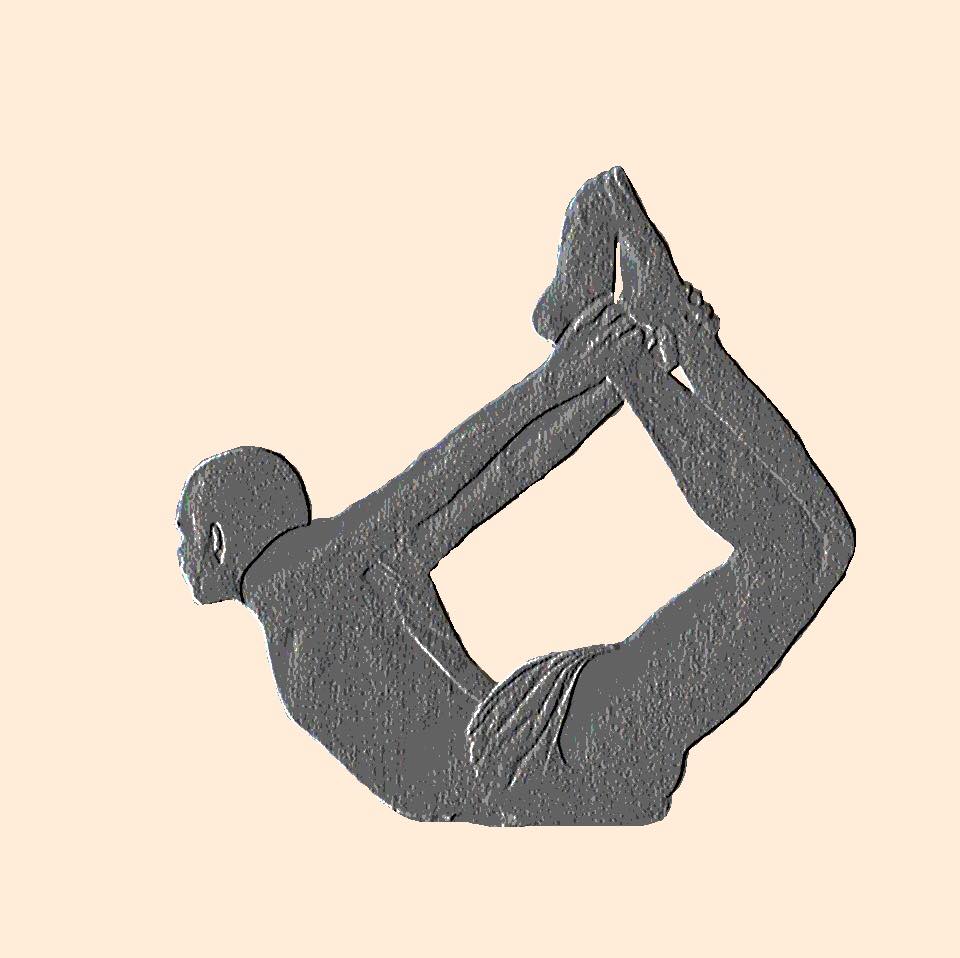
1. Lie on the floor full length on the abdomen, face down.
2. Exhale and bend the legs at the knees. Stretch the arms back and catch the left ankle with the left hand and the right ankle with the right hand. Take two breaths.
3. Exhale completely and pull the legs up, lifting the knees and at the same time lifting the chest off the floor. The arms and hands act like a bowstring, drawing the body taut like a bow.
4. Lift the head and take it back as far as possible. Neither the ribs nor the pelvic bones should touch the floor. Only the abdomen bears the weight of the body.
5. As you lift the legs, do not bring the knees together, as this makes it difficult to raise them high enough. Only when the legs are fully stretched up should you join the thighs, the knees and the ankles.
6. Since the abdomen is stretched, the breathing will become faster, but this is nothing to worry about. Stay in the pose, if possible, for 20 seconds to 1 minute.
7. Then, with an exhalation, release the ankles, stretch the legs straight, lower the head and the legs to the floor and relax.
Dhanurasana in detailTranslated from Sanskrit, “dhanu” means “bow”. This seemingly simple device allows a skilled archer to hit any target, even one that is hard to make out. For Dhanurasana truly to reproduce the shape of a bow, the body has to curve evenly and the arms have to be taut like a bowstring. Then the pose will help to strengthen the muscles of the back and open the shoulder joints, will make the spine flexible and will cure the habit of stooping. Thanks to the intense stretch of the front of the body, the chest opens, the collarbone area is extended and the quadriceps are strengthened. The pose increases the flow of blood to the digestive organs, as a result of which the work of the stomach, the liver and the intestines improves. In addition, Dhanurasana stimulates the work of the kidneys and the adrenal glands.
Like most backbends, Bow Pose provides an influx of strength and fills you with energy. So if you suffer from insomnia, it is not worth practising the asana in the second half of the day; it is better to include it in a morning session. In shape and in effect Dhanurasana resembles Bhujangasana (Cobra Pose) and Salabhasana (Locust Pose), which are often done in preparation for Bow Pose. At the same time Dhanurasana may seem the easier asana, since holding the feet or the ankles creates an additional support for the backbend and helps you keep your balance. However, you can easily become carried away by the shape of the asana and injure your lower back. To avoid this, do not strain, and make the backbend in the thoracic region, increasing the space between the vertebrae.
incorrect
Do not throw the head back. Lengthen the neck instead.
correct
Take the feet away from the buttocks.
For a while it is worth doing variations of the pose in order to protect the knees and to prevent compression in the lower back. Before drawing the bowstring of Dhanurasana, do the variations in which you do not have to catch the ankles with your hands. Lie on your abdomen, place the legs hip-width apart and stretch the arms along the body with the palms facing down. Bend the legs at the knees so that the shins are perpendicular to the floor and the soles face the ceiling. Exhale completely and on an inhalation lift the head, the shoulders and the chest to a height that is comfortable for you - so that the neck stays long. Extend the spine, taking the crown of the head upwards. On an exhalation lift the thighs off the floor, trying to raise the feet as high as possible. Hold this position for two or three breath cycles. Lengthen the lower back, directing your exhalations into the lumbar region. Then come out of the pose and relax completely.
The variation of Bow Pose in which you catch only one leg is suitable if the quadriceps are stiff, if the shoulder joints are not mobile enough, and also if there are problems in the knee joints. Lie on your abdomen and stretch the arms forward. Bend the right leg at the knee and catch the ankle with the right hand. On an exhalation take the right heel away from the buttock and, through this movement, take the head and the right shoulder even further from the floor. Extend the left arm, press it into the floor and push down with the palm in order to stabilise the pose. Remain in this position for three breath cycles.
To do this variation of Dhanurasana, place a strap under the shins in the shape of the letter U. Lie on your abdomen and catch the ends of the strap with your hands. Bend the legs, placing the feet and the knees hip-width apart. Extend and spread the toes and move the strap onto the ankles. Move the hands along the strap as close to the ankles as possible. Now bring the heels towards the buttocks, drawing in the abdominal muscles. Take a few breaths in and out, lengthening the tailbone, and on an inhalation begin to take the shins away from the buttocks, lifting the chest off the floor and opening the shoulder joints. Keep your balance on the pubic bone and the front groin area. Reach the crown of the head towards the ceiling, lengthening the cervical spine. Direct your gaze upwards, but do not throw the head back. If the neck becomes compressed - keep looking forward instead.
Once you have mastered the variation with the strap, you can try the full version of the pose. Get ready, catch the ankles and on an inhalation lift up into Dhanurasana. Stay in the pose for 2-5 breath cycles, actively lifting the chest and the feet upwards and balancing on the pubic and pelvic bones. Take the shins back and lengthen the lower back, directing your exhalations into the sides of the waist. Make sure the buttock muscles do not clench. If you stop feeling the extension of the spine, come out of the pose and relax completely. To counterbalance the effect of Bow Pose, do Balasana.
In the classical Dhanurasana the legs should be together. But in order to protect the lower back, keep them hip-width apart. In the “Yoga Sutras” Patanjali says that an asana should be steady (sthira) and comfortable (sukha). So watch your sensations attentively, and when tension or discomfort appears, go back to the simpler variations. And one more thing: it is not worth worrying about how your pose looks from the outside. Let the main criterion in your practice be the feeling of joy and the influx of energy that correctly performed backbends give. (Yoga Journal)
The effects of practising DhanurasanaIn this pose the spine is stretched backwards. Elderly people usually do not make such movements, and their spine loses its flexibility. This asana restores flexibility to the spine and tones the abdominal organs. Regular practice of Dhanurasana and Salabhasana brings relief to people suffering from displaced vertebrae.